
2027 direction.
Design-led micromolding.
Our 2027 strategy advances GIH from contract manufacturing toward design-led micromolding for optical and semiconductor-packaging applications, supported by an SMT PCBA carve-out.
Define the function before the feature size.
| Target area | Feasibility questions |
|---|---|
| Optical applications | Explore polymer components for optical assemblies. A candidate brief should identify optical or mechanical function, interface geometry, material, surface requirements and alignment tolerances. Optical function, surface finish and dimensional performance drive the development brief. |
| Semiconductor packaging | Explore polymer-component opportunities associated with semiconductor packaging. Define thermal, dimensional, electrical, contamination and assembly requirements. Our development focus is the polymer component and its role in the packaging assembly. |
Precision engineering already in place.
- SolidWorks design and in-house CNC / EDM tool fabrication.
- Precision plastic molding to ±0.01 mm on agreed features, materials and processes.
- Robotic molding automation and in-house tool/machine-management software.
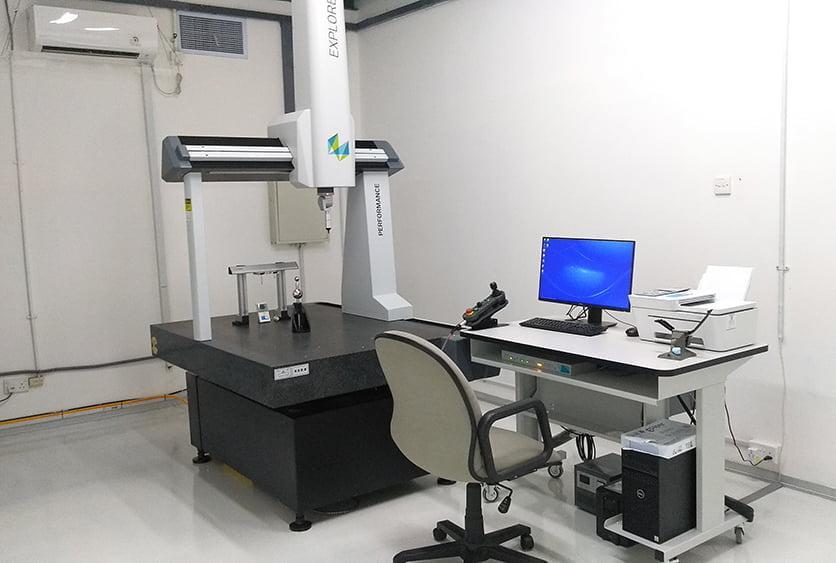
- CMM and SmartScope metrology, connected to assembly and defined test requirements.
Our next stage connects this engineering foundation with application-specific micro-feature, material, surface and measurement requirements.
Turn an opportunity into a measured capability.
- 01
Application definition
Select a component-level problem and agree the functional, dimensional, material and volume requirements.
- 02
Feasibility & measurement
Determine whether the required feature can be tooled, molded, handled and measured using a suitable process.
- 03
Tooling & process development
Scope tool detail, resin delivery, temperature control, filling, ejection and handling for the selected part.
- 04
Sample validation
Compare representative samples against the agreed drawing and functional requirements; document limitations and open risks.
- 05
Production qualification
Define repeatability, inspection, contamination control if needed, traceability, packaging and customer release.
Bring a component-level micromolding brief.
- Application and required function, rather than only a target part size.
- 3D geometry, smallest critical feature, surface and dimensional requirements.
- Candidate materials, environmental exposure and assembly interfaces.
- Volume, validation standards, cleanliness requirements and qualification timeline.
Quotation target: 1 week from a complete technical brief. Production, tooling and qualification schedules are scoped separately.